Date: Wednesday, June 17, 2026
Time: 15:00–16:30 CET
Format: Online
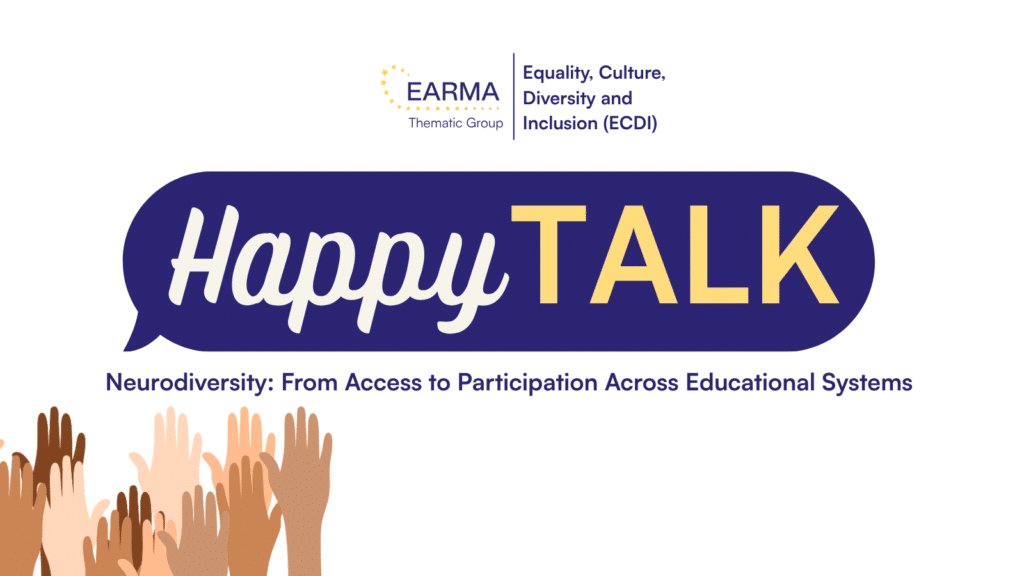
Organised by: EARMA’s Equality, Culture, Diversity and Inclusion (ECDI) Thematic Group
Summary
The next EARMA Happy Talk invites participants to explore how educational systems can move beyond providing access toward enabling meaningful participation for neurodivergent individuals across the life course.
Bringing together perspectives from research, educational practice, and organisational change, this session will examine how inclusive environments are shaped not only by individual support measures but also by institutional culture, interdisciplinary collaboration, organisational learning, and system-level approaches.
The session will be led by Verónica Vidal Velasco and Daniela Wachholtz Martorell from the Research Center for Student Mental Health (ISME), School of Education, Faculty of Social Sciences, Universidad de los Andes (Chile).
About the session
Despite significant progress in inclusive education policies, many educational systems still struggle to create environments where neurodivergent individuals can participate meaningfully and sustainably across different stages of education and professional life.
In this Happy Talk, Verónica and Daniela will present experiences and research developed in Chile across school and higher education contexts, including participatory and community-based initiatives focused on neurodiversity and inclusion. Their work explores how inclusive practices emerge and are sustained through the interaction between professional knowledge, organisational structures, attitudes, and broader socio-cultural contexts.
Using socioecological and implementation-informed perspectives, the speakers will reflect on the importance of interdisciplinary collaboration, continuity of support, and organisational conditions that enable inclusive cultures to flourish over time.
For research managers and administrators, the session offers a valuable opportunity to reflect on how research design, institutional practices, funding structures, and organisational processes can contribute to more connected, sustainable, and context-responsive approaches to inclusion.
This Happy Talk will be particularly relevant for professionals interested in research culture, inclusion, wellbeing, organisational change, and equitable participation in research and educational environments.
Speakers
Verónica Vidal Velasco
Research Center for Student Mental Health (ISME), School of Education, Faculty of Social Sciences, Universidad de los Andes
Verónica Vidal Velasco is a Speech-Language Pathologist and Assistant Professor at the School of Education, Universidad de los Andes (Chile). Her work focuses on inclusive education, neurodiversity, and communication, with particular emphasis on system-level approaches to support the participation of neurodivergent learners across educational contexts.
Her research integrates socioecological perspectives to examine how inclusive practices are adopted and sustained within schools and higher education institutions. She has led and collaborated on different participatory and community-based projects in Chile aimed at strengthening interdisciplinary practices and organisational conditions for inclusion.
Verónica also serves as Section Editor for the Revista Chilena de Fonoaudiología and as Director of Education on the National Board of the Chilean College of Speech-Language Pathologists.
Daniela Wachholtz Martorell
Research Center for Student Mental Health (ISME), School of Education, Faculty of Social Sciences, Universidad de los Andes
Daniela Wachholtz Martorell is an Occupational Therapist and Associate Professor at the School of Education, Universidad de los Andes (Chile). Her work focuses on neurodevelopment, sensory integration, and inclusive education, with particular emphasis on systemic strategies to support self-regulation and participation of neurodivergent learners across clinical and educational contexts.
Integrating socioecological frameworks, her research explores how educational institutions can effectively sustain inclusive practices over time. Her experience in participatory projects in Chile focuses on promoting interdisciplinary work within schools, bridging professional gaps, and optimising organisational environments to foster inclusive cultures across both K–12 and higher education.
Registration
Please register your attendance via the registration form.
The meeting link will be shared with registered participants shortly before the event.