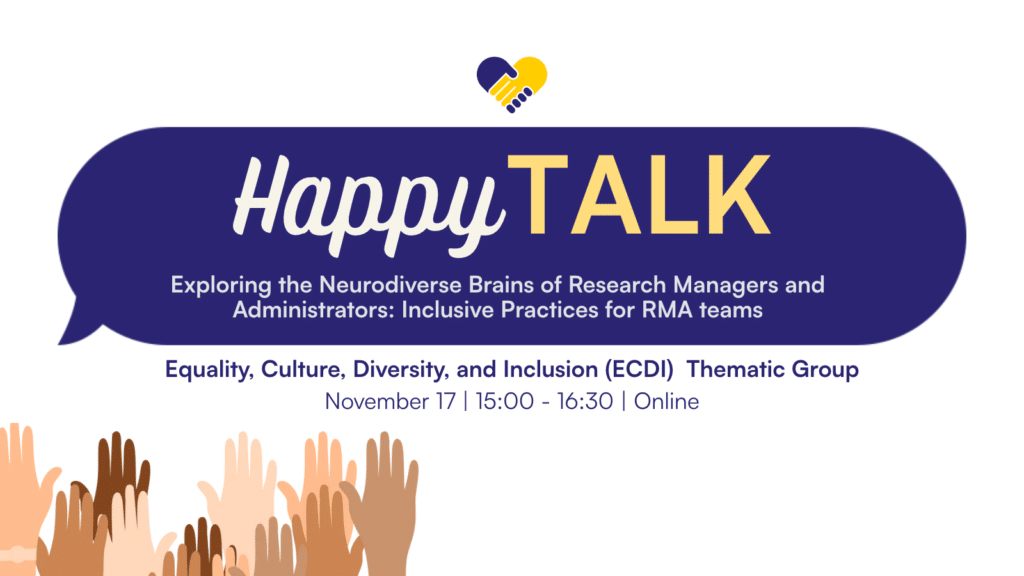
Date: Tuesday, November 17, 2026
Time: 15:00–16:30 CET
Format: Online
Organised by: EARMA’s Equality, Culture, Diversity and Inclusion (ECDI) Thematic Group
Summary
Neurodiversity is increasingly recognised across higher education, but institutional attention often focuses primarily on students. What about the Research Managers and Administrators working within those same institutions?
The next EARMA ECDI Happy Talk turns the lens towards the RMA community itself. Matthias Held and Geerte Slappendel, members of the EARMA ECDI Thematic Group, will explore how neurodivergence can shape the everyday working experiences of RMAs — from navigating administrative processes and institutional communication to contributing distinctive strengths and perspectives within RMA teams.
The session will combine professional expertise, practical experience and personal perspectives to consider how we can make RMA workplaces, communication and processes more inclusive of different ways of thinking and working.
About the session
Neurodiversity refers to the natural variation in how human brains function, including differences in areas such as attention, learning, communication, sociability, mood and information processing.
Within higher education, neurodivergent RMAs may encounter processes, communication styles and working environments that were not designed with neurodiversity in mind. At the same time, neurodivergence can bring strengths and perspectives that are particularly valuable across many areas of research management and administration.
This Happy Talk will explore the diversity of ways in which RMA brains work. Matthias and Geerte will discuss some of the challenges neurodivergent RMAs may experience in their daily work and consider practical approaches to adapting communication and organisational processes to make them more inclusive.
For research managers and RMA teams, recognising and responding to different ways of thinking, communicating and working can help make services more effective while contributing to a more positive, supportive and inclusive workplace.
As always, the Happy Talk will provide space for participants to exchange experiences, ask questions and reflect together on what more inclusive RMA practice can look like.
Speakers
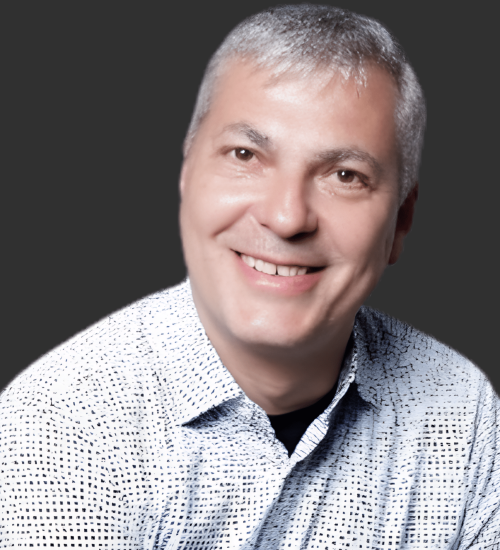
Matthias Held, PhD
Research Associate, Research Promotion Service (RPS) Euresearch Office Fribourg, University of Fribourg, Switzerland
Matthias Held holds a PhD in Biology and has experience in research, teaching, and the coordination of research projects and networks. For more than ten years, he has worked as a research manager in the grant office of the University of Fribourg, where he supports researchers across disciplines in identifying funding opportunities, developing strong proposals and planning their careers.
He also provides guidance on European funding programmes and coordinates wider research-related activities. He particularly enjoys working across disciplines, supporting researchers in developing their ideas into successful projects, and collaborating within supportive and engaged teams.
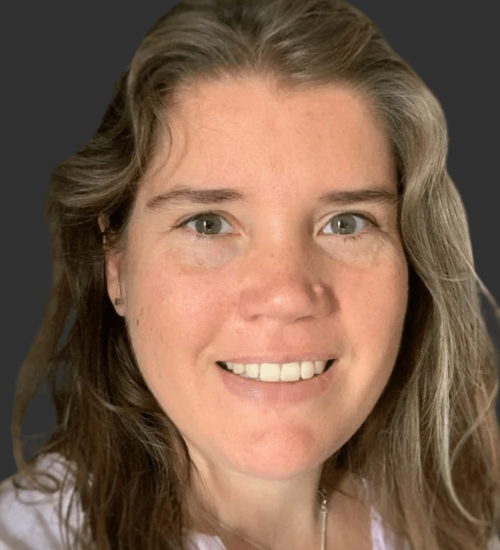
Geerte Slappendel
Staff Advisor for EDI in a Research Context, UMC Utrecht
Geerte Slappendel entered research management with a Master’s degree and extensive doctoral training in clinical psychology.
Over the past decade, she has moved from post-award research management into policy work on equality, diversity and inclusion within the Research Office at UMC Utrecht, alongside research on mainstreaming gender analysis in biomedical research.
She is a member of the UMC Utrecht EDI Core Team and the EARMA ECDI Thematic Group. Having been diagnosed with ADHD as an adult, she brings to the discussion a combination of professional expertise and personal experience of neurodiversity.
Why join the Happy Talks series?
The Happy Talks are an online series organised by the EARMA Equality, Culture, Diversity and Inclusion (ECDI) Thematic Group, creating a supportive and interactive space for the RMA community to explore issues related to equality, diversity, inclusion, wellbeing and research culture.
Through presentations, practical examples and open discussion, the series aims to bring greater visibility to topics that can have a significant impact on how we work together across research environments.
Registration
Participation is free, but registration is required.
The meeting link will be shared with registered participants shortly before the event.